The stock market attracts thousands of new traders every year, especially in a financial hub like Mumbai. But most beginners enter with the same problems: they watch random YouTube videos, copy tips from Telegram groups, open trades without risk management, and then wonder why losses happen so quickly.
This is where a Stock Market Course In Mumbai can be worth considering. A structured course can help beginners understand how markets work, how to read charts, how to manage capital, and how to avoid emotional trading mistakes.
The need for proper training is even stronger today. SEBI reported that 93% of individual equity F&O traders lost money between FY22 and FY24, with aggregate losses crossing ₹1.8 lakh crore.
So, the real question is not just “Should I learn trading?” The better question is: “Should I learn trading in a disciplined, practical, risk-aware way before putting real money at risk?”
Is a Stock Market Course In Mumbai Worth It?
Yes, a Stock Market Course In Mumbai is worth it for aspiring traders if it offers practical training, live market practice, risk management, technical analysis, and mentoring. It helps beginners avoid common trading mistakes and build a structured approach instead of depending on tips, emotions, or random online content.
What is a Stock Market Course In Mumbai?
A Stock Market Course In Mumbai is a structured training program that teaches beginners, investors, and aspiring traders how to understand financial markets, analyze stocks, use trading platforms, read charts, manage risk, and create trading strategies.
A good course usually covers:
- Basics of stock market and indices
- Equity, intraday, swing trading, and derivatives
- Technical analysis and chart patterns
- Risk management and position sizing
- Trading psychology
- Live market practice
- Practical assignments and doubt-solving
In simple words, it helps you move from guessing trades to making informed trading decisions.
Why Do Aspiring Traders Need Stock Market Training?
Trading looks simple from the outside. You buy, sell, and make profit. But in reality, markets are affected by price action, liquidity, news, institutional activity, volatility, and human psychology.
Here is why training matters:
- Most beginners lack a process: They enter trades without a plan.
- Risk management is ignored: Many traders risk too much on one trade.
- Emotions control decisions: Fear and greed lead to overtrading.
- F&O trading is risky: SEBI’s data shows that most retail derivative traders lose money.
- Mumbai has high market exposure: Being a finance-driven city, many learners want hands-on trading knowledge.
- Online information is scattered: Free videos can help, but they rarely provide a complete roadmap.
Mini Summary Box
A course is useful because it creates structure. Instead of learning randomly, students follow a guided path from basics to practical trading.
How Does a Stock Market Course Work?
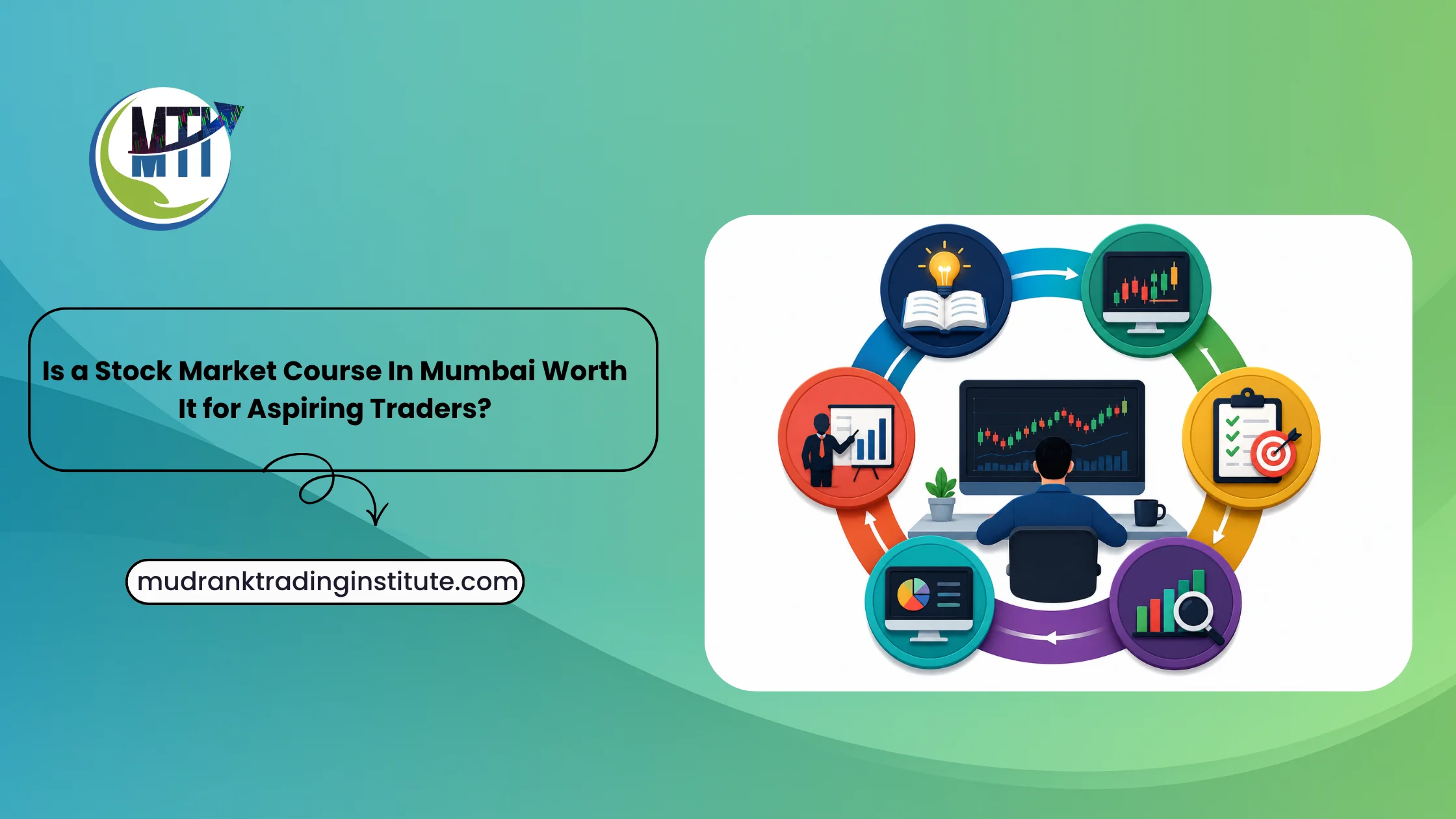
A well-designed stock market course usually follows a step-by-step learning process.
Step 1: Understanding Market Basics
Students first learn about NSE, BSE, stocks, indices, sectors, brokers, demat accounts, and order types.
Step 2: Learning Technical Analysis
This includes candlestick patterns, support and resistance, trendlines, volume, moving averages, RSI, MACD, and price action.
Step 3: Building Trading Strategies
Learners understand how to create entry, exit, stop-loss, and target rules instead of trading randomly.
Step 4: Practicing in Live Markets
The best stock market classes in Mumbai include live market observation. This helps students see how price moves in real time.
Step 5: Risk and Money Management
Students learn how much capital to risk, how to avoid revenge trading, and how to protect their account.
Step 6: Review and Improvement
Good traders maintain journals, review mistakes, and improve their strategy over time.
This is why many learners search for the Best stock market course in Mumbai for beginners with practical trading training rather than only theoretical lessons.

Benefits of Joining Stock Market Classes
A practical course offers several advantages for beginners and working professionals.
- Structured learning: You know what to learn first, next, and later.
- Live market exposure: You understand real-time price behavior.
- Better discipline: You learn when not to trade.
- Risk awareness: You stop treating trading like gambling.
- Mentor support: Doubts get solved faster.
- Local classroom advantage: For learners searching “share market classes near me,” offline support can improve consistency.
- Confidence building: Practice reduces hesitation.
- Career foundation: It can support future roles in trading, investing, research, or advisory education.
India’s participation in markets has grown sharply. SEBI’s monthly bulletin reported that overall demat accounts stood at 20.5 crore at the end of August 2025, showing rising interest in equity markets.
Stock Market Course vs Self-Learning vs Online Videos
| Learning Option | Best For | Pros | Limitations |
|---|---|---|---|
| Stock market institute in Mumbai | Beginners who need structure | Mentorship, live practice, doubt-solving | Requires time and course fees |
| YouTube/self-learning | Curious learners | Free, flexible | Scattered, no accountability |
| Books | Long-term learners | Deep concepts | Less practical for live execution |
| Paid online course | Remote learners | Convenient | May lack live market interaction |
| Telegram tips/groups | No serious learner | Quick calls | High risk, no learning, no control |
For serious learners, a classroom or hybrid course can be more effective because it combines theory, market practice, and feedback. That is why people often compare the Best trading institute in mumbai, Best stock market classes in mumbai, and best share market classes in mumbai before enrolling.
Who Should Join a Stock Market Course?
A Stock Market Course In Mumbai is suitable for:
- College students who want to understand markets early
- Working professionals looking for a second income skill
- Business owners who want to manage capital better
- Beginners who have lost money due to tips or emotional trading
- Investors who want to understand charts and market timing
- Homemakers interested in financial independence
- Traders who want to improve discipline and risk management
It is also useful for people searching for the Best stock market classes in Mumbai near me for beginners and working professionals, especially if they prefer guided learning.
Cost and Pricing Factors
The cost of stock market training can vary depending on course depth, trainer experience, location, duration, and practical exposure.
Common pricing factors include:
- Beginner or advanced level
- Offline, online, or hybrid format
- Live market training availability
- One-on-one mentorship
- Duration of the course
- Certification or practical assignments
- Post-course support
- Access to recorded sessions or study material
A basic course may cost less, but an advanced practical trading program with live sessions and mentoring will usually cost more.
Instead of choosing only the cheapest option, compare value. A low-cost course without practical learning may not help much. The right course should teach process, risk control, psychology, and execution.
Industry Trends in 2026
The trading education industry is changing fast in 2026. Learners are no longer satisfied with only theory. They want practical skills, live examples, and risk-focused education.
Key trends include:
- More demand for practical training: Beginners want live chart reading, not just textbook definitions.
- Risk management is becoming central: After SEBI’s repeated warnings on F&O losses, responsible institutes are focusing more on capital protection. SEBI-linked investor education material notes that derivatives are high-risk products and not recommended for most retail investors.
- Hybrid learning is growing: Students want offline classes plus recordings.
- Algo and data awareness is increasing: SEBI proposed bringing algorithmic and proprietary trading more directly into stockbroker regulations in 2025, showing how technology is shaping market structure.
- Regulatory focus is rising: SEBI has continued reviewing derivatives activity because retail trader losses remain high. Reuters reported that the regulator has looked at steps to improve derivatives market quality.
- Beginners want local trust: Searches like “trading classes in mumbai” and “stock market institute in mumbai” show that learners still value local guidance.
Mini Summary Box
In 2026, the best trading courses in India are expected to focus less on shortcuts and more on live practice, risk control, psychology, and responsible trading education.
Why Choose Mudrank trading Institute in Mumbai?
Mudrank trading Institute can be a strong choice for learners who want structured stock market education in Mumbai with a practical mindset.
Here is what aspiring traders should look for:
- Beginner-friendly explanation of market concepts
- Practical technical analysis training
- Live market examples
- Focus on risk management
- Simple teaching style
- Strategy-based learning instead of tip-based trading
- Doubt-solving and mentoring support
- Suitable guidance for beginners and working professionals
For anyone comparing the Top trading institute in Mumbai for share market classes and live market practice, Mudrank trading Institute should position its training around clarity, discipline, and real-world market preparation.
The right institute does not promise guaranteed profit. Instead, it teaches students how to think, plan, manage risk, and improve over time.
FAQs
1. Is a Stock Market Course In Mumbai good for beginners?
Yes. A beginner can benefit from a structured course because it explains market basics, chart reading, trading psychology, and risk management step by step.
2. Which is better: online or offline stock market classes?
Offline classes are useful for live interaction and discipline. Online classes are flexible. A hybrid model is often best because it offers both convenience and personal guidance.
3. Can I become a full-time trader after completing a course?
A course can build your foundation, but full-time trading requires practice, capital discipline, emotional control, and consistent performance over time.
4. What should I check before joining trading classes in Mumbai?
Check the syllabus, trainer experience, live market practice, reviews, risk management coverage, support system, and whether the course avoids unrealistic profit claims.
5. Are stock market courses worth the money?
Yes, if the course teaches practical skills, risk control, and real trading discipline. It is not worth it if it only sells tips, signals, or guaranteed-profit claims.
Ready to stop guessing and start learning the market with structure?
Join Mudrank trading Institute and build your trading foundation with practical learning, live market understanding, and risk-focused guidance. Whether you are a beginner, student, working professional, or aspiring trader, the right training can help you approach the market with confidence and discipline.